Madrid
Los pacientes del doctor GarcíaMadrid is the novel’s shifting center of concealment and return: a city where clandestine patients seek care beyond official institutions, covert agents arrange meetings behind ordinary social routines, and old comrades encounter the consequences of war decades later. Its streets and rooms do not provide safety so much as temporary cover, making the city a landscape of repeated exposure, retreat, and recognition.
A city of clandestine care
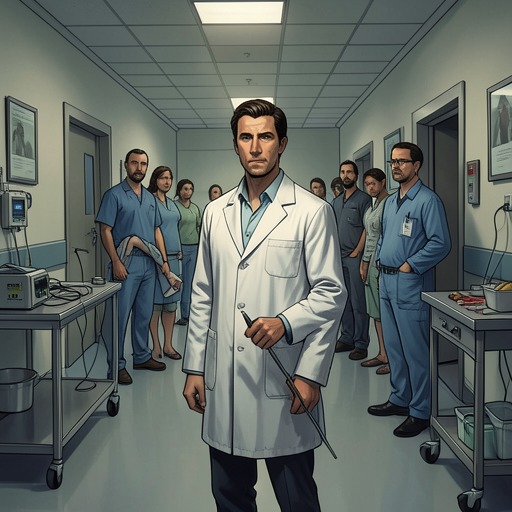
By the period when Manuel’s underground medical practice had become established, the needs of his patients had changed. Guerrilla groups in the mountains had built basic medical support: members could disinfect wounds, bandage, splint, and sew, while serious cases might be taken to doctors in nearby villages. Yet Madrid still brought Manuel gunshot victims laid out on dining-room tables. The hardened veterans of earlier years had increasingly given way to very young students, striking workers, and others without military training, who confronted the police with near-suicidal resolve. Many patients, however, were not fighters at all. They were poor people connected to anti-Franco families or communists, or friends of communists, unable to afford private treatment or unwilling to show their papers at a hospital.
That work made the city’s domestic interiors part of an informal medical network. A dining table could become an emergency treatment surface; the decision to seek a clandestine doctor could reflect poverty as much as political risk. Madrid’s ordinary spaces thus acquired a double function: they belonged to daily life, but could also absorb people excluded from public care or endangered by official scrutiny.
Covert meetings in public and private
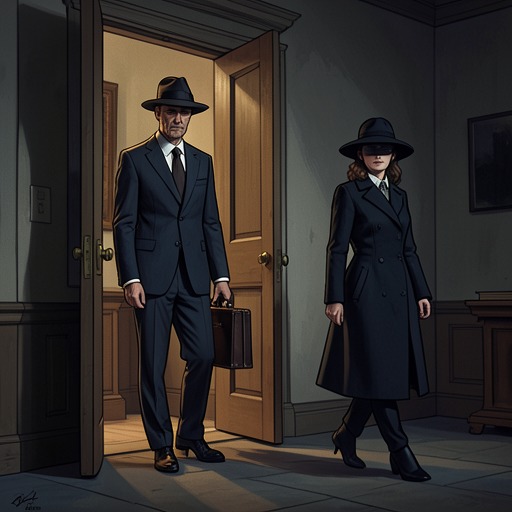
Madrid also served as a meeting ground for people whose identities and loyalties had to remain hidden. In a dark, winding wine cellar, Manuel and Meg sometimes met at the farthest corner, where only two tables stood and waiters had to be summoned from the distant bar. A small door in the rear wall opened onto stairs leading up to the square. Neither had needed to use it to escape, but Manuel sometimes entered or left that way; Meg always used the main entrance. The carefully secluded setting suited their encounters, yet Manuel did not choose it for meetings with Guillermo, because his relationship with Guillermo was different.
Secrecy could also depend on appearing to have nothing to hide. Miss Williams, an American trade official who kept her participation in Francoist government social events to a minimum, was nevertheless widely known. If any Spanish associate of Clara Stauffer had seen her drinking with a fugitive on the Allied wanted list, her mission would have been compromised. The false Adrián Gallardo, by contrast, did not mind being seen with the false Rafael Cuesta in a bright café with large windows on Alcalá Street. He would be the first to rise if he noticed an acquaintance, performing openness as a kind of alibi. On 7 December 1948, however, the Lion seemed too exposed for such a meeting. Madrid’s cafés and cellars offered no single formula for safety: visibility could serve as cover, but it could also undo an operation.
The city’s political and commercial routines furnished further settings for covert business. On 17 January 1949, the enterprise that had begun the previous year moved into a scheduled appointment arranged by Steinbauer, who summoned Manuel to number 57 Juan Bravo Street at half past four the following afternoon. Manuel said he would still be working at that hour and asked whether they could meet later. Steinbauer refused. The fixed time and address turned an ordinary business appointment into a point of entry into the next phase of the operation.
War’s aftermath in the city
Madrid’s postwar landscape remained shaped by people trying to resume lives broken by the conflict. On New Year’s Day 1950, Zacarías González Peña entered the Casa de Campo at six in the morning, as he did every day, followed by sixty-eight sheep. The war had taken him away from a familiar ravine and his pastoral work. After serving two years in prison for fighting as a private in the Republican army, he had completed another three years of military service. On returning home, he found that Mari, his wife, had only four animals left from the flock they had assembled when they married. He rebuilt gradually, earning the trust of neighbors who entrusted him with their livestock. That morning, in the hollow where his sheep led him, he found another dead body. The pastoral routine and the discovery of a corpse occupy the same landscape, setting the labor of reconstruction against the persistence of violence.
Madrid’s geography also bears the pressure of an earlier, remembered ordeal. In October 1968, the prison’s brick façade revived in Guillermo a bodily memory of the spring of 1939, when he had wandered through the city day after day to avoid going mad alone in a room at the Moderno guesthouse in Puente de Vallecas. The prison encounter was therefore not an isolated visit: the approach to its walls carried him back to the city of defeat and anxious survival. The intervening years had not erased that experience; Madrid’s built environment could bring it forward again.
A stage for resistance and recognition
The city’s public institutions could become part of political resistance. In May 1968, while Rita attended a meeting about the Communist Party’s response to protests at the Complutense, Guillermo took his daughters to the Cine Paz. The outing became memorable not for the film or its songs, but for the chant that entered its soundtrack: “¡Obreros y estudiantes, unidos y adelante!” The slogan joined workers and students in a phrase that connected the family’s ordinary cinema visit to the unrest and political debate beyond it.
Months later, Madrid’s Carabanchel Prison became the destination of another act of concealment. On 26 October 1968, Guillermo entered using a forged Madrid Bar Association card lent by Ángel Valverde Roldán, who did not know him. The forged card was so convincing that, according to Ricardo, Valverde never believed it was inauthentic. Paired with a court paper identifying its bearer as defense counsel for José Antonio Urbieta Priego, it allowed Guillermo to pass into the prison without difficulty. The visit required not only a false credential but also careful use of the prison’s procedures: lawyers met prisoners in a divided room, with a small window in the partition and a guard who would ordinarily wait nearby. Madrid’s legal architecture thus became a route through which a hidden relationship could approach a prisoner.
By late 1976 and early 1977, the city was also a place of reunion between men whose shared history had outlasted their assumed names. On 30 December 1976, Guillermo and Manuel embraced at the arrivals door of Barajas International Terminal. Guillermo’s hair was gray; Manuel’s was entirely white. Guillermo had put on weight, while Manuel had become the thinner of the two. Their bodies bore different marks of time, and Manuel was covered in scars that Guillermo’s hands had sewn. Neither used his real name, yet each called the other by his authentic one. Each owed the other his life. For a moment, the embrace made them feel young and strong again, before the hope that had joined them was recalled as something that had left them stranded in defeat.
When Guillermo saw Manuel again at the Lion in Madrid on 12 January 1977, the reunion preceded explanation: they had exchanged far more embraces than accounts of what had happened. Manuel called their situation a nightmare and said he had no choice but to return, describing the same misery as before, here and there, everywhere. Madrid could reunite the friends, but it could not promise that return meant escape from the conditions that had driven them apart.
The city as a structure of recurrence
Across these episodes, Madrid is not simply a backdrop for successive periods of the plot. Its rooms and institutions repeatedly turn into thresholds: the dining table receives the wounded; the cellar separates secret companions from the street; the business office and café provide settings where visibility must be managed; the prison summons memories of 1939; Barajas makes reunion possible, while the Lion frames a return shadowed by renewed trouble. The city’s recurring pattern is one of provisional shelter followed by exposure, and of return that reopens rather than resolves the past. Political life, medical care, family memory, and friendship intersect there because each depends on navigating the same uncertain boundary between what can be shown and what must remain concealed.